
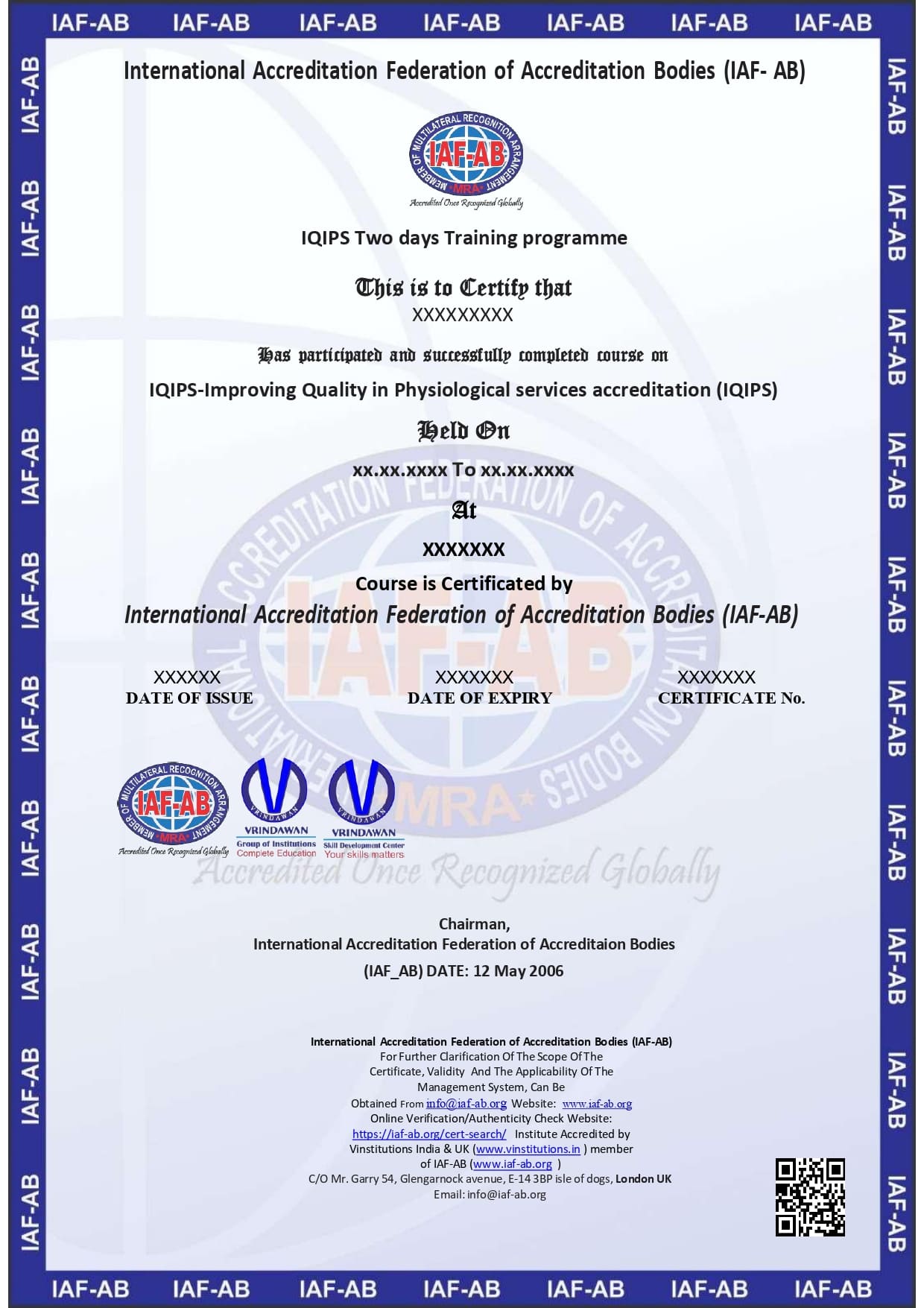
2 DAYS TRAINING PROGRAMME
CLASSROOM & DISTANCE LEARNING COURSE
IQIPS- IMPROVING QUALITY IN PHYSIOLOGOCAL SERVICES ACCREDITATION
Dear Sir,
As is widely known, IAF-AB is conducting various technical courses inviting interested personnel/technocrats for enhancing & fine-tuning of the skill.
IAF-AB organizing 2 Days Training Programme Classroom & online Training course for IQIPS-Improving Quality in Physiological services accreditation series management system.
1.INTRODUCTION ON IQIPS
The standards published by ISO undergo changes periodically, to reflect the best-suited practices over the changing times. ISO series of standards For a business unit to successfully set up an IQIPS-Improving Quality in Physiological services accreditation management systems or get maximum benefits from an established management system, auditors within the organization have to be trained to assess the system IQIPS-Improving Quality in Physiological services accreditation requirements. They must also be able to assess their suppliers required management system to support own Quality Initiative.
To increase professionalism, quality auditors also seek formal registration with the IAF-AB (UK & INDIA) one of the prerequisites for such registration requires the quality auditors and practitioners to successfully complete an IAF-AB (UK & INDIA) approved auditor training.
2. OBJECTIVE OF THE COURSE ON IQIPS
The objective of the course is to illustrate the importance of the 2 days Training Programme role, skills and competency in bearing the ultimate responsibility for the effective performance of the audit team. A practical and intensive course for training quality professionals to External, Internal and manage third and second party audits of an IQIPS-Improving Quality in Physiological services accreditation Management System.
Course describes how to plan and perform an audit, report findings, conduct opening and closing meetings and establish follow-up action. You will understand by the end of the course how regular auditing by an audit team directed by a competent internal auditor is the foundation of an effective IQIPS-Improving Quality in Physiological services accreditation Management System. On completion of the course, you will have the necessary skills and the experience to Internal Audit and manage your own audits. The learning process will include a
series of tutorials, exercises, culminating in both practical and written examination. Delegates will be supplied with a bound set of comprehensive course notes.
3. COURSE CONTENTS:
- Introduction to IQIPS-Improving Quality in Physiological services accreditation Management System
- Vocabulary & understanding definitions
- Introduction to IQIPS-Improving Quality in Physiological services accreditation – Management System Requirements
- Need for Internal Quality Audits
- Auditing Techniques
- Conducting Internal Quality Audits
- Course Examination with minimum 50% passing marks.
3. Scope of the Training
This training applies to internal audits of physiological services seeking or maintaining accreditation, including but not limited to:
-
Cardiac physiology and cardiology diagnostics
-
Respiratory and sleep services
-
Neurophysiology services
-
Vascular diagnostics
-
Gastrointestinal physiology
-
Audiology and related diagnostic services
The training is relevant for both public and private healthcare providers operating physiological diagnostic services.
4. Overview of IQIPS – Improving Quality in Physiological Services
4.1 Purpose
IQIPS is designed to improve the quality and consistency of physiological services by focusing on:
-
Patient safety and patient experience
-
Clinical effectiveness and outcomes
-
Competence and development of staff
-
Robust governance and leadership
-
Continuous quality improvement
IQIPS accreditation provides assurance to patients, clinicians, regulators, and commissioners that physiological services meet defined quality standards.
4.2 Key Principles
IQIPS is built on core principles that include:
-
Patient-centred care
-
Evidence-based practice
-
Risk management and safety culture
-
Professional accountability
-
Transparency and continuous improvement
Internal audits are essential to demonstrating these principles in practice.
5. IQIPS Standards and Structure
IQIPS standards are typically organised around key domains, such as:
-
Patient Experience – dignity, consent, communication, and feedback
-
Facilities, Equipment, and Resources – suitability, safety, and maintenance
-
Workforce – competence, training, and staffing levels
-
Clinical Care and Diagnostic Accuracy – protocols, quality assurance, and reporting
-
Safety and Risk Management – incident reporting, infection control, and safeguarding
-
Leadership and Governance – accountability, policies, and quality oversight
This training explains how each domain translates into auditable requirements.
6. Role of Internal Audits in IQIPS Accreditation
Internal audits within IQIPS serve to:
-
Assess compliance with IQIPS standards
-
Identify gaps before external assessment
-
Monitor effectiveness of quality improvement actions
-
Support risk-based decision-making
-
Provide evidence for governance and management review
Internal audits are not merely compliance checks but tools for improving service quality and patient outcomes.
7. Target Participants
This training is suitable for:
-
Internal auditors in healthcare organisations
-
Physiological service managers and leads
-
Quality and clinical governance professionals
-
Healthcare accreditation coordinators
-
Senior clinicians involved in service oversight
8. Benefits of the Training
Organisations benefit through:
-
Improved compliance with IQIPS standards
-
Enhanced patient safety and service quality
-
Better preparedness for external IQIPS assessments
-
Stronger clinical governance and risk management
-
Continual improvement across physiological services
9. Conclusion
IQIPS accreditation represents a commitment to excellence in physiological services. Internal auditing is a critical mechanism for ensuring that this commitment is embedded in daily practice. This 2-Day Internal Auditor Training on IQIPS provides participants with the knowledge, skills, and confidence to conduct effective audits that support patient safety, clinical effectiveness, and continuous improvement.
By developing competent internal auditors, healthcare organisations strengthen their quality infrastructure and ensure sustainable compliance with IQIPS accreditation requirements.
10. Certification
Participants who successfully complete the training will receive a:
“Internal Auditor – IQIPS (Improving Quality in Physiological Services)” Certificate
This certification demonstrates competence in auditing physiological services against IQIPS standards.
Day 1: Introduction to IQIPS and Quality Improvement in Physiological Services
Session 1: Overview
Introduction
-
- Definition and significance in healthcare
- Historical context and development of IQIPS standards
- Key principles of quality improvement in physiological services
Session 2: Understanding Accreditation in Physiological Services
- The role of accreditation in healthcare
- Overview of national and international accreditation standards
- Benefits of achieving accreditation for healthcare providers
Session 3: Quality Management Systems (QMS) in Physiological Services
- Principles of quality management in healthcare
- Developing and implementing a QMS aligned
- Documentation and record-keeping requirements for accreditation
Session 4: Assessing Quality in Physiological Services
- Key performance indicators (KPIs) for physiological services
- Methods for evaluating service quality
- Tools for quality assessment (e.g., audits, patient feedback, peer reviews)
Group Activity:
- Participants will work in groups to analyze a case study of a healthcare provider seeking accreditation and identify key areas for quality improvement.
Day 2: Implementing Standards and Future Directions
Session 5: Implementing
- Steps to achieve
- Preparing for the assessment process
- Roles and responsibilities of the accreditation team
- Strategies for successful implementation of IQIPS standards in clinical practice
Session 6: Engaging Stakeholders in Quality Improvement
- Importance of stakeholder involvement in quality improvement initiatives
- Strategies for effective communication and collaboration with staff and patients
- Role of training and education in fostering a culture of quality
Session 7: Case Studies of Successful IQIPS Accreditation
- Real-world examples of healthcare providers that have successfully achieved IQIPS accreditation
- Discussion of challenges faced and lessons learned
- Strategies for continuous quality improvement post-accreditation
Session 8: Future Trends in Physiological Services and Accreditation
- Emerging trends and technologies impacting physiological services
- The evolving landscape of healthcare accreditation
- Preparing for future changes in standards and practices
Group Activity:
- Participants will develop a quality improvement plan for a fictional healthcare provider, outlining steps to achieve and maintain IQIPS accreditation.
Closing Session:
- Q&A session to clarify participant queries
- Discussion on the importance of ongoing professional development in maintaining accreditation
- Feedback collection from participants regarding the training programme
Learning Outcomes:
Upon completion of this training programme, participants will be able to:
- Understand the principles and significance of physiological services.
- Navigate the accreditation process and implement best practices for achieving and maintaining.
- Assess and improve the quality of physiological services using established metrics.
- Recognize future trends that will impact physiological services and accreditation standards.
Delivery Method:
- Classroom Training: Interactive lectures, group discussions, case studies, and hands-on activities.
- Distance Learning: Recorded lectures, online discussions, virtual group activities, and assessment quizzes.
Materials Provided:
- Course handbook and supplementary materials
- Access to online resources and additional reading materials
- Certificates of completion
This structured content aims to provide participants with the knowledge and skills necessary to enhance the quality of physiological services through effective accreditation practices and continuous improvement initiatives.
For detail of contents refer our website at https://iaf-ab.org/
4. WHO SHOULD ATTEND:
1) All employees whose work responsibility directly affects Improving Quality in Physiological services accreditation.
2) Those individuals willing to take up external auditing as a future profession by becoming an independent auditor.
3) Those who intend to enroll themselves to IAF-AB (UK & INDIA) Registration Schemes of Improving Quality in Physiological services accreditation .
4) Management Representatives responsible for effective implementation and execution of Improving Quality in Physiological services accreditation
FACILITIES:
All facility for delegates covering lecture hall, tea and lunch will be arranged by Client or if you are attending the course at IAF-AB office. IAF-AB institute will arrange the above facility.
COURSE DETAILS:
Detail program of every days training course will be sent / given on the first day to the delegates on registration.
DURATION:
Two days Training program for Improving Quality in Physiological services accreditation [Timings: 10.00 am to 6.00 pm]
FEES:
- 2 Days Training program of Improving Quality in Physiological services accreditation is Rs 10500+18%GST
Payment should be made by Cheque / DD in favour of “IAF-AB, Mumbai”
j) NOMINATIONS:
You may send in your nominations to the course co-coordinator, IAF-AB, on the Registration form at the following address along with the fees.
Ranjeet Prasad
+91 8369083940
B-401, New Om Kaveri CHS Ltd, Nagindaspara,
Next to shiv sena office,
Nalasopara (E), Dist. Palghar – 401209, Mumbai, Maharashtra
Email : info@iaf-ab.org
Tel:+91 0250-2341170
Fees once paid will not be refunded, however it could be adjusted against the next course for the same financial year.
Please send your nomination of the delegated immediately as limited seats are available. Seats are filled on first cum first serve basis.
k) TERMS & CONDITIONS:
I. IAF-AB general terms and conditions will be applicable for qualification of
personnel.
II. Minimum candidates per batch should be 04 Number and Maximum should be 25
per batch. 10% discount will be offered for 04 Number and Maximum should be 25
per batch
III. Delegate Fees shall be send in advance through cheque / DD in favor of
<IAF-AB” payable at Mumbai.
IV. IAF-AB will charge Service tax as applicable.
V. Travel & Subsistence by 3rd AC train or economy class airfare will be charged for
faculties on actual to be borne by client in case of course will be conducted inhouse at client premises.


Reviews
There are no reviews yet.